
 21 January 2026
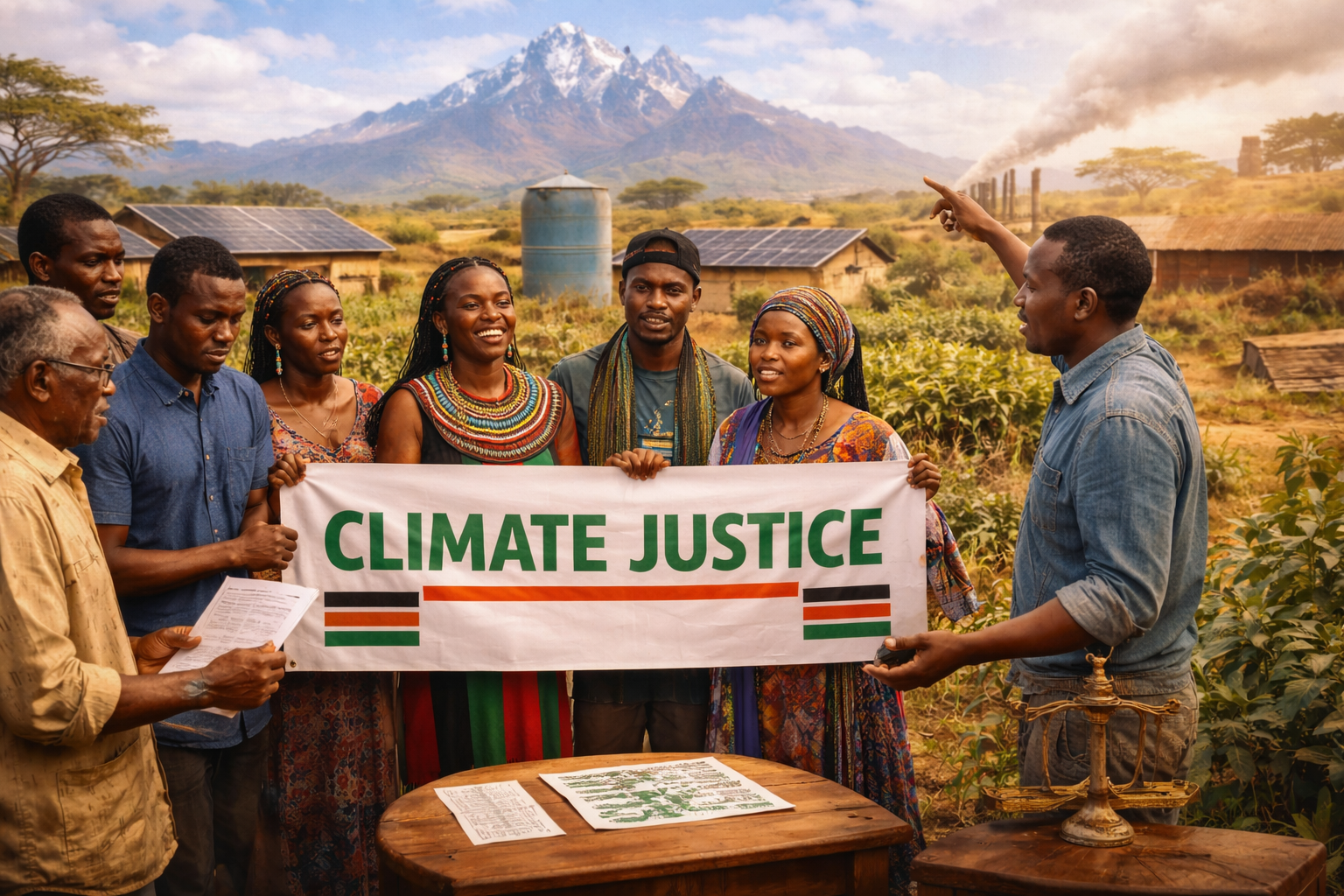
Climate justice asks a simple but powerful question: Who is paying the highest price for climate change, and is it fair?
The answer is clear: communities that have done the least to cause climate change often the poor, marginalized, and vulnerable are the ones paying the highest price, facing devastating floods, prolonged droughts, food insecurity, and forced displacement.
Understanding Climate Justice in the Kenyan Context
Climate justice goes beyond the environmental protection. It looks at the climate action through the lens of human rights. It emphasizes on:
- Protection of human rights
- Equity in climate decision-making
- Fair distribution of climate resources
- Inclusion of marginalized voices
In Kenya, climate justice means ensuring that adaptation and mitigation efforts do not deepen existing inequalities but instead promote dignity, resilience, and sustainable development for all.
Climate justice in Kenya demands a shift in perspective from treating climate change as a purely environmental problem to recognizing it as a human rights issue.
How Climate Change Impacts the Vulnerable Communities
Kenya’s economy and livelihoods are highly climate dependent. The impacts of climate change are particularly severe for:
- Pastoralist communities in arid and semi-arid lands, who face recurrent droughts and loss of livestock
- Small-scale farmers, affected by erratic rainfall and crop failure
- Coastal communities, threatened by sea-level rise and flooding
- Urban poor, especially those in informal settlements vulnerable to floods, heat stress, and poor sanitation
These communities have limited resources to adapt, making climate change not just an environmental issue, but a question of justice and survival.
Role of the Courts in Climate Justice
Kenyan courts have increasingly become important arenas for advancing climate justice. The judiciary has affirmed that environmental protection and public participation are constitutional requirements.
In the case of Save Lamu & 5 Others v National Environmental Management Authority (NEMA) & Another (2019), the court emphasized meaningful public participation in environmental decision-making, particularly where large-scale projects affect local communities.
Similarly, in the case of Okiya Omtatah Okoiti v Attorney General & 2 others; Francis K. Muthaura (AMB) & 5 others (Interested Parties) [2019], the court recognized the importance of environmental rights and citizen involvement in decisions affecting natural resources.
These cases demonstrate how litigation can be a powerful tool for holding institutions accountable and protecting vulnerable communities.
Challenges of Achieving Climate Justice
Despite strong laws and active advocacy, challenges remain:
- Weak enforcement of environmental laws
- Limited access to climate finance for grassroots communities
- Inadequate inclusion of marginalised groups in decision making
- Political and economic interests overriding environmental concerns
Addressing these challenges is essential to realizing meaningful climate justice.
Conclusion
Climate justice in Kenya is all about ensuring that climate action is fair, inclusive, and rights based. It demands that those most affected by climate change are placed at the centre of solutions and not left behind.
Through strong laws, active courts, community participation, and accountable governance, Kenya has the foundation to advance climate justice. The task ahead is to translate these principles into real protection, resilience, and equity for all.
By Mary Mwende, Lawyer – A.N. Kamau & Co. Advocates